Realm Defense: Hero Legends TD
- 4.4
- Rating
- 5.00M
- Installs
- Free
- Price

 Analysis by App-foxy
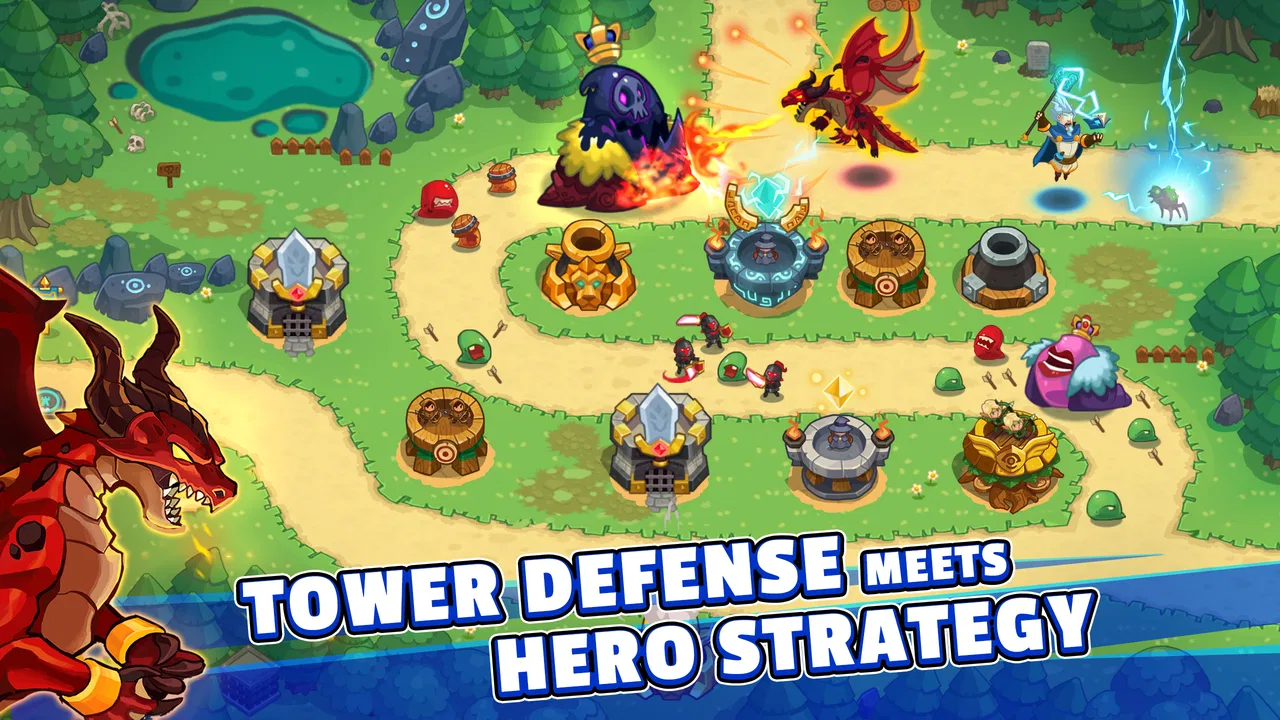
Realm Defense: Hero Legends TD is the kind of arcade strategy game I open when I want a short battle with a clear purpose rather than a long, complicated session. The basic idea is easy to understand: enemies advance toward a castle, and I place defensive units to stop them before they get through. What makes the experience more interesting is the gradual shift from simply reacting to enemy waves toward planning where every defensive choice matters.
I found the game approachable during the opening stages, but it is not completely mindless. The early maps teach the rhythm of watching a route, identifying the dangerous approach, and spending resources at the right moment. That makes it a comfortable fit for players who enjoy tower defense games but do not want to begin with a dense interface or a long tutorial. At the same time, anyone expecting a purely casual game may be surprised when later battles start demanding more deliberate timing.
How the first battles establish a useful routine
The strongest part of the opening is its clarity. I can see the path enemies follow, understand where defenses belong, and quickly tell when a position is helping or wasting space. That direct feedback gives the first sessions a satisfying loop: begin a stage, watch the route, improve the defense, and try again with a better plan if the castle is overwhelmed.
You May Also Like

 Blood Strike: 2.5 Anniversary
Blood Strike’s Loadouts Turn Every Drop Into a Tactical Gamble
A close look at Blood Strike’s custom loadouts: how fast access to signature weapons reshapes its battle royale rhythm, rewards preparation, and narrows the gap between fights.

 Pandora - Music & Podcasts
Pandora’s Music Is Easy to Start, but Harder to Recover
Pandora’s strength is its low-effort path from a seed to a station. Its weak spot is how much confidence it asks you to place in connection, setup, and quiet recovery.

 8 Ball Pool
 Is Built on Rivalries, Rematches, and Routine
A close look at the rivalries, rematches, shared routines, and unanswered safety questions that turn a quick pool match into a persistent mobile community.

 Samsung Music
’s Quiet Strength Is Playing What You Already Own
Its reach comes less from spectacle than from dependable access to a personal library. That simplicity is both the app’s strongest retention engine and its ceiling.

 AccuWeather: Weather Radar
AccuWeather Review: A Quick, Clear Forecast for Everyday Decisions
For everyday plans, the best forecast is the one you can understand quickly. AccuWeather makes rain timing, radar, and local conditions easy to act on, with a few trade-offs.

 Hill Climb Racing
Why Hill Climb Racing Still Turns Crashes Into One More Run
A tiny car, a bumpy hill and one more upgrade: Hill Climb Racing keeps resurfacing because its simple chaos makes every near-miss feel personal.
More From Our News Desk



Those early goals matter because they are immediate rather than abstract. I am not playing only to fill a progress bar; I am trying to survive the next push and protect the end of the path. The game’s arcade identity shows here. It keeps the action readable and focused, while the strategy comes from deciding which part of the route deserves attention first.
I also like that the opening encourages observation. A player who spends resources as soon as they become available may survive an easy wave, but that habit can become inefficient once threats arrive from different directions or with different levels of pressure. I learned to watch the first part of a wave before committing everything, especially when a stronger defensive position could cover more of the route.
A practical everyday use case is a short break between tasks. I can play a stage without needing to dedicate an entire evening, then put the game down after a failed attempt and return with a new idea. It works better for that pattern than strategy games that require long preparation before anything meaningful happens.
Small decisions make the opening more engaging
The useful lesson in the early game is that placement is not just about building the strongest option immediately. A defense near the beginning of a route may weaken enemies early, while one closer to the castle may be more valuable because it catches anything that survives. I found myself balancing safety against efficiency instead of treating every available position as equal.
Another worthwhile habit is to avoid changing the whole setup after every mistake. When a stage goes badly, I first look for the exact point where the defense failed. Was the problem an exposed section of the route, poor timing, or too much investment in one side? Making one controlled adjustment usually teaches more than rebuilding everything without understanding the cause.
This is where the game begins to separate itself from very simple mobile defense titles. The controls remain accessible, but the better results come from reading the battlefield. Players who enjoy experimenting will find more value here than players who only want to tap the most obvious upgrade and watch the result.
Progress feels clearest when each win changes the next decision
Progression works best when it gives me a new reason to reconsider familiar habits. Finishing stages and moving forward creates a visible sense of advancement, but the more important signal is practical: a strategy that worked earlier may need adjustment later. That keeps victories from feeling like empty routine because each new challenge tests whether I actually understood the previous lesson.
The game’s long-term appeal depends on this relationship between goals and unlocks. I enjoy progression when a reward expands my options instead of merely making old content easier. Here, the motivation comes from wanting to see what the next part of the campaign asks me to handle and whether a different defensive approach will solve it.
I would not describe the pacing as equally exciting at every moment. Some stages feel like preparation for a later test, and players who need constant novelty may find that rhythm uneven. Still, the slower sections can be useful. They give me room to refine placement and resource timing before the game asks for faster decisions.
One of the more effective ways to play is to treat a completed stage as a lesson rather than a final answer. If I win comfortably, I pay attention to which defenses did most of the work and which ones were unnecessary. That makes future attempts more efficient and prevents me from spending resources simply because they are available.
What progression rewards in practice
The most satisfying progress is not just reaching another map. It is recognizing that I now understand the route structure better than I did a few sessions earlier. I can identify dangerous bends sooner, preserve room for a late response, and avoid panicking when one section begins to collapse. That kind of improvement is especially rewarding because it comes from the player, not only from stronger numbers.
There is also a useful distinction between progress that helps immediately and progress that teaches a reusable skill. A stronger defensive option may rescue one stage, but learning how to delay an enemy or cover a vulnerable lane can help across many situations. I recommend focusing on the latter whenever possible, because it makes the game feel less dependent on simply collecting more power.
For a new player, I would set modest goals: clear one difficult stage, understand why the previous attempt failed, and improve the opening setup without spending impulsively. That approach keeps the campaign manageable and makes the progression feel earned rather than rushed.
The difficulty curve rewards patience but can expose weak habits
The difficulty curve is gentle at first and becomes more demanding as the game expects better planning. Early success can create the impression that every stage will be solved through the same arrangement, but that confidence does not always survive a tougher wave. I appreciated that change because it gave the campaign a reason to continue beyond learning the basic controls.
Difficulty becomes most interesting when the problem is not simply that enemies are stronger. A stage can feel harder because the route gives less time to react, because a defensive position covers less than expected, or because spending everything early leaves no answer for the final push. Those situations encourage me to think about timing, not just power.
My main advice is to resist restarting too quickly. Watching a failed attempt for a few moments can reveal whether the real weakness is at the front, in the middle, or near the castle. If I restart immediately, I may repeat the same mistake with slightly different placements. If I observe the collapse, the next attempt becomes a real experiment.
The challenge will appeal to players who like learning through repetition. It may frustrate people who want every stage to be predictable or who dislike replaying a level after a narrow defeat. This is not a game I would recommend to someone looking for a passive experience with no pressure. Even though the presentation is accessible, success eventually requires attention.
Where the challenge feels fair and where it creates friction
I generally find the challenge fair when the game gives me enough information to understand what went wrong. The route is visible, the castle’s danger is obvious, and the result of poor placement becomes clear during the battle. That transparency makes a failed attempt easier to accept because I can connect the outcome to a decision.
The friction appears when a player is unsure whether to improve a familiar setup or pursue a different approach entirely. Without a patient testing mindset, it is easy to interpret a defeat as a demand for more progression rather than a sign that the current plan is inefficient. I recommend changing one variable at a time before deciding that a stage is beyond reach.
There is also a pacing trade-off. Replaying a stage can be satisfying when I am close to solving it, but less enjoyable when the opening sequence becomes repetitive. Players who prefer fast, constantly changing arcade rounds may find the strategic retries slower than expected. Those who enjoy gradually optimizing a defense are more likely to appreciate the same structure.
Retention comes from goals, but the free structure deserves attention
The game is free to play, which makes it easy to try without an upfront purchase. It includes in-app purchases ranging from $0.99 to $99.99 per item, so I would approach the store carefully and decide in advance whether I want to spend anything. The useful question is not only whether an optional purchase is available, but whether buying changes the kind of challenge I want from the game.
For me, the best reason to return is the desire to solve a stage more cleanly, not the feeling that I must keep checking in. That distinction matters. A healthy session ends when I have learned something or reached a natural stopping point. If progression begins to feel like pressure to spend or grind rather than an invitation to improve, the experience becomes less appealing.
I would recommend setting a personal rule before playing: enjoy the free progression first, and only consider a purchase if it genuinely improves your preferred way to play. This is especially sensible for younger players, since the content rating is Everyone 10+ and the purchase range includes both small and very large amounts. The game can be enjoyed casually, but household purchase controls are still a practical precaution.
The retention design works best for people who like returning to a familiar game with a new plan. It is less convincing for players who need a constant stream of fresh mechanics or a strong social layer to stay interested. Realm Defense is built around the satisfaction of defending, failing, adjusting, and eventually succeeding, so its long-term pull depends heavily on whether that loop feels rewarding to you.
Who should install it and who should skip it
I would point this game toward someone who wants a readable arcade strategy experience with enough difficulty to reward attention. It suits players who enjoy short sessions, visible objectives, and the small satisfaction of improving a setup after a failed attempt. It is also a good introduction for someone curious about tower defense but not ready for a complicated strategy interface.
I would be more cautious recommending it to players who dislike repetition, optional purchases, or gradual progression. If you want a game that delivers its full range of possibilities immediately, this may feel too measured. Likewise, if your ideal arcade game is based on reflexes alone, the placement and timing decisions may seem slower than the action you expected.
Compared with very basic tower defense alternatives, this game offers more room for planning and adaptation. Compared with deeper strategy titles, it is easier to pick up and less demanding to understand at the start. That middle position is its strength: it provides meaningful decisions without turning every battle into a spreadsheet. The trade-off is that expert strategy fans may eventually want more complexity than the streamlined format provides.
My progression verdict after playing through its rhythm
Realm Defense: Hero Legends TD sustains play most effectively when I treat each stage as a small strategic puzzle. The early goals are clear, the progress signals are easy to recognize, and the rising difficulty gives successful decisions more weight. I especially value the way the game encourages me to diagnose a failure instead of blindly repeating it.
Its weaker side is the possibility of repetition. The same basic loop that makes the game approachable can also feel narrow if I am not interested in refining defenses over multiple attempts. The free-to-play structure and broad in-app purchase range are another reason to play intentionally rather than chasing progress without a limit.
The game comes from Babeltime US, carries an average rating of 4.4 from around 441 thousand ratings, and has passed 5 million installs. Those figures fit my impression that it has found a substantial audience, but they are not a substitute for knowing your own preferences. I would judge it by whether you enjoy the moment when a previously impossible wave becomes manageable after one smart change.
It was released on October 30, 2016, and the current version is 3.4.41, with support beginning at Android 5.1. The age rating is Everyone 10+, and the game remains free to start. For me, those details make it an easy title to test, provided I keep the purchase settings in mind.
My recommendation is positive for patient players who want accessible tower defense with a gradually sharper challenge. I would install it for short breaks, play several attempts when I am in the mood to optimize a route, and stop when the game starts feeling like obligation instead of entertainment. It is not the deepest strategy game in the category, nor is it the fastest arcade experience, but its balance of clear goals, visible improvement, and tactical retries gives it a distinct place between those two styles.
FAQs for Realm Defense: Hero Legends TD
01What is Realm Defense: Hero Legends TD?
Realm Defense: Hero Legends TD is a fantasy tower defense game for Android and iOS. You defend kingdoms from waves of monsters by placing heroes, towers, and special abilities along enemy paths. Each hero has different strengths, upgrade options, and skills, so success depends on choosing the right team and adapting your strategy to each map rather than simply relying on one powerful character.
02Is Realm Defense: Hero Legends TD free to download and play?
Yes, Realm Defense: Hero Legends TD can be downloaded and played for free, but it includes optional in-app purchases. You can progress through the campaign, unlock heroes, and improve your defenses without paying immediately, although some upgrades, resources, or progression options may take time to earn. Players who prefer faster advancement should review the available purchases and spending settings before playing.
03Does the game require an internet connection?
An internet connection may be needed for certain features, including account synchronization, advertisements, events, updates, and in-app purchases. Some parts of the game may remain accessible when you are offline, but offline availability can vary by device and game version. If you plan to play while traveling or without reliable data, it is best to test the game beforehand rather than assume every mode works offline.
04Is Realm Defense suitable for beginners?
Realm Defense is approachable for newcomers because its early stages introduce tower placement, hero abilities, enemy types, and upgrades gradually. However, later levels become considerably more demanding and may require careful timing, repeated attempts, and thoughtful resource management. Players who enjoy experimenting with different heroes and defensive layouts will likely find the learning curve rewarding, while casual users may find advanced stages challenging.
05What are the main advantages and disadvantages of Realm Defense: Hero Legends TD?
The game’s main advantages include colorful fantasy visuals, a broad selection of heroes, varied tower-defense maps, special abilities, and strategic gameplay that encourages experimentation. It also offers substantial content for players who enjoy long-term progression. On the other hand, some upgrades and unlocks can feel slow without additional spending, advertisements may interrupt the experience, and difficult stages can create a noticeable grind for players seeking quick progress.
Pros
- Smooth tower-defense gameplay with responsive controls and clear visuals.
- Large roster of heroes
- each offering distinct abilities and tactical roles.
- Regular events and challenges provide extra goals beyond the campaign.
- Offline play is available for many stages
- useful when traveling without internet.
- Strategic depth grows through hero upgrades
- tower placement
- and enemy variety.
Cons
- Later stages can become highly grindy without frequent play or resource spending.
- Some heroes and upgrades require substantial time or premium currency to unlock.
- Difficulty spikes may force repeated attempts or specific hero combinations.
- Energy
- timers
- or other progression limits can interrupt longer play sessions.
- The amount of menus
- currencies
- and upgrade systems may overwhelm new players.

Realm Defense: Hero Legends TD
Gallery